The fundamental concept behind Taijiquan and the basis for its martial applications is clearly represented by the yin-yang symbol for Taijiquan:
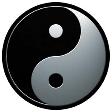
In Taijiquan, one almost never counters against an attacking force with an opposite frontal counter force with the purpose of overpowering that attacking force with a larger counter force. Instead, the Taijiquan practitioner usually sidesteps to avoid the frontal attack either completely, or partially and at the same time uses a small side force to deflect the attacking force. The Taijiquan practitioner basically allows the attacker to continue in the direction of his force, and utilizes that momentum to cause the opponent to lose his balance. Once the opponent senses that he may lose his balance and moves in the opposite direction, the Taijiquan practitioner also changes direction and counterattacks along the momentum of the opponent’s new motion.

Retiremeent: Opportunity for Rebirth
After working for 35 years, I recently (at the end of January 2006) retired. Actually I was laid off, and that made my decision to retire slightly early a very easy decision. During the last 10 months, I have really enjoyed my retirement. As a matter of fact, I found that this past year since retirement is probably one of the best years of my life.
If one can satisfy the requirements of good health and financial stability, then retirement provides a golden opportunity for rebirth. By that, I mean that one can do the many things that one really enjoys doing, but never found enough time to do before. Of course, what one enjoys doing varies with the individual.
Read More »