Don Tow's Website2026-09-25T00:28:28Zhttp://www.dontow.com/feed/atom/WordPressDonhttp://dontow.com<![CDATA[Three Important Announcements]]>https://www.dontow.com/?p=96332026-09-25T00:28:28Z2026-09-25T00:20:59ZImportant Announcement I – United States is changing its basic structure to the world. The world can see more clearly what the real U.S is like.
Important Announcement II – My health
Due to my recent health issues, my health is not the same as before. I have lost a lot of my basic memory. Fortunately, a lot of my long term memory seems to be there. I will not update my website as frequently as before.
Important Announcement III – My book talk
My book talk on my book The Yin and Yang of the Dragon and the Eagle: Tale of Two Cultures and Two Countries will be on Thursday October 29, 2026 from 7:30 PM – 9:30 PM. The 10/29/2026 talk will be a private talk at our church, but it will be a taped talk which can be repeated at other occasions.
]]>Donhttp://dontow.com<![CDATA[A South China Morning Post Editorial “How Chinese philosophy influenced US founding fathers”]]>https://www.dontow.com/?p=96042026-07-09T16:23:47Z2026-07-09T16:23:47ZThis was an editorial opinion by Chow Chung-yan, Editor-in-Chief of the South China Morning Post (SCMP) on 6/26/2026. I am reprinting this article.
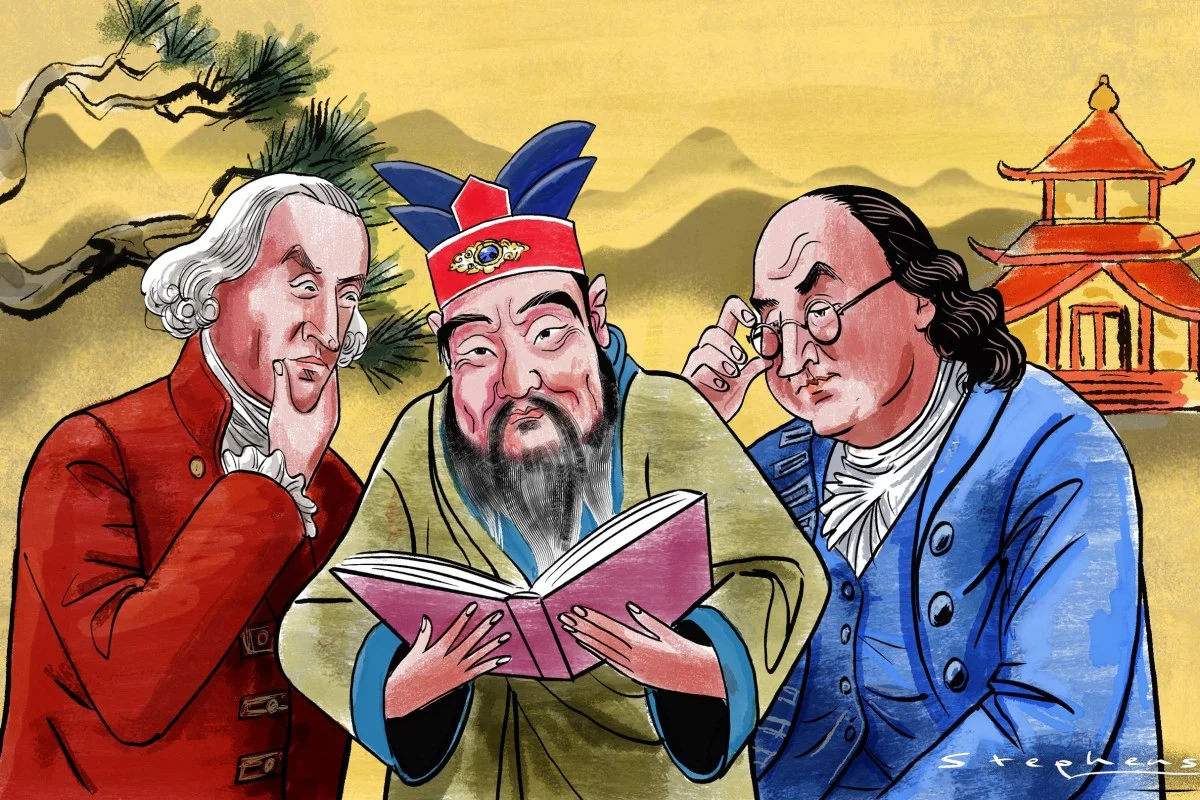
“Founding Father, Benjamin Franklin, published the sayings of Confucius in his colonial newspaper and today’s sculpture recognising that ancient Chinese age is carved into the face of the United States Supreme Court very proudly,” said US President Donald Trump in Beijing last month.
[Of all the presidents of the U.S., such a positive comment coming from President Trump, who has been very critical of China, must be true and meaningful. This comment was not part of the original editorial comment by Mr. Chow, it is an added comment by me.]
It took two-and-a-half centuries for an American president to explicitly acknowledge the profound Chinese impact on the US founding fathers. Trump’s recent declaration could be a historical first. Unless archival evidence surfaces to suggest otherwise, he is the first US president to formally recognise this intellectual gap on the world stage.
This admission stands in stark contrast to our current geopolitical discourse. Today, Western political commentary frequently depicts China as the ultimate cultural and ideological antithesis to the West. Yet, a deeper dive into history reveals that ancient Chinese philosophy did not just sit on the periphery of Western thought; it actively inspired both the European Enlightenment and the American founders.
To see this connection hidden in plain sight, one need only look at the architecture of American democracy itself. Sitting atop the East Pediment of the US Supreme Court building is a monumental trio of ancient lawgivers: Moses, Solon and Confucius.
Sculpted by Hermon MacNeil in the 1930s under the direction of architect Cass Gilbert, these figures were chosen to represent the core foundational pillars of American jurisprudence. MacNeil wanted to trace the lineage of American law. He included Confucius because he believed that true justice must prioritise collective civic virtue and social harmony over mere individual rights. Today, this statue of Confucius sits directly above the window of the chief justice’s office suite, serving as a silent, historic guardian watching over the highest judicial seat in America.
The Supreme Court pediment, however, is merely the physical manifestation of a deep intellectual current. While it would be a stretch to suggest that Thomas Jefferson sat down with The Analects to draft the Declaration of Independence, the structural parallels between ancient Chinese thought and American revolutionary ideals are unmistakable.
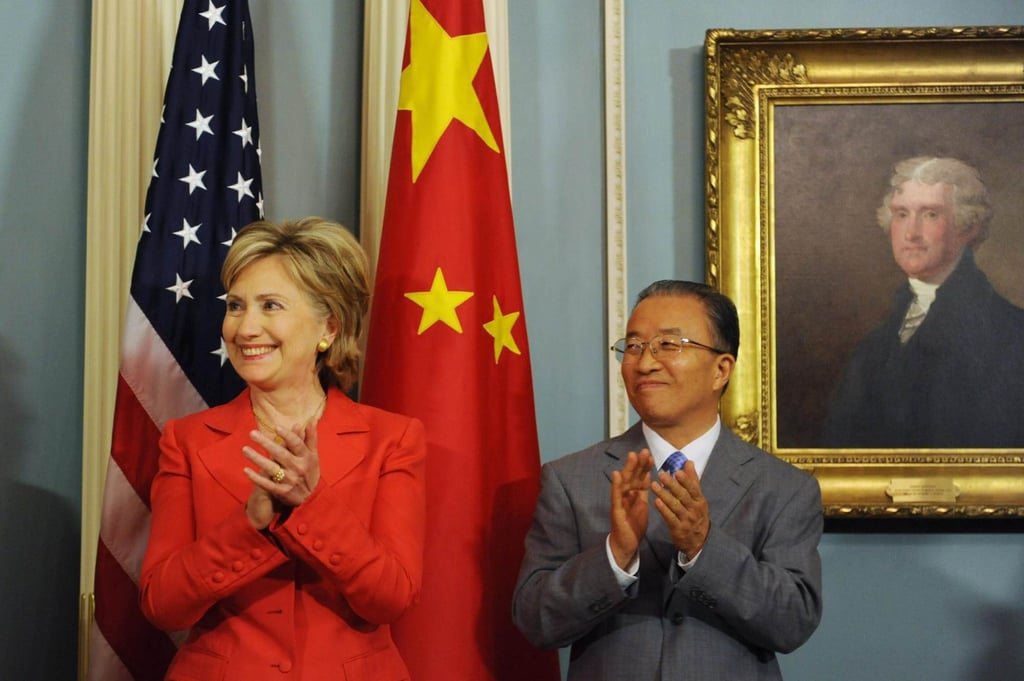
Then US secretary of state Hillary Clinton and then state councillor Dai Bingguo applaud beside a portrait of former US president Thomas Jefferson during the signing of a memorandum of understanding on clean energy and climate change in Washington on July 28, 2009. Photo: EPA
Both Jefferson and Franklin were avid consumers of literature detailing Chinese governance. The declaration’s foundational premise that “all men are created equal” was a radical departure from the rigid British aristocratic class system. Historian Martin Powers, professor emeritus at the University of Michigan, argues convincingly that the American founders did not construct their democratic and egalitarian frameworks in an intellectual vacuum. His research shows that both Jefferson and Franklin drew immense inspiration from Chinese political structures, particularly the concept of a merit-based state apparatus.
Jefferson championed what he termed a “natural aristocracy”, an elite class defined strictly by virtue, education and talent, rather than an “artificial aristocracy” anchored to birthright and inherited wealth. Franklin took this critique of inherited status a step further by directly citing Chinese tradition. Defending his opposition to hereditary honours, he wrote: “Thus among the Chinese, the most ancient, and from long Experience the wisest of Nations, honour does not descend, but ascends.” In the Chinese model, honours were granted to parents based on the achievements of their children, a concept that completely inverted European feudal logic.
Even the iconic American phrase “the pursuit of happiness”, traditionally credited to John Locke or the Greek philosopher Epicurus, heavily mirrors the Confucian and Mencian doctrine of the Mandate of Heaven. Mencius argued that the ultimate legitimacy of any government rests on a singular metric: its capacity to secure the tangible well-being and contentment of its populace. This philosophy remains the bedrock of Chinese governance today.
Furthermore, Mencius asserted that if a ruler fails this test and oppresses his people, he loses the Mandate of Heaven, giving the populace a legitimate right and moral duty to overthrow him. The rhetorical echo in the Declaration of Independence is striking. Jefferson writes that when a government becomes destructive to the people’s safety and happiness, “it is their right, it is their duty, to throw off such Government”.
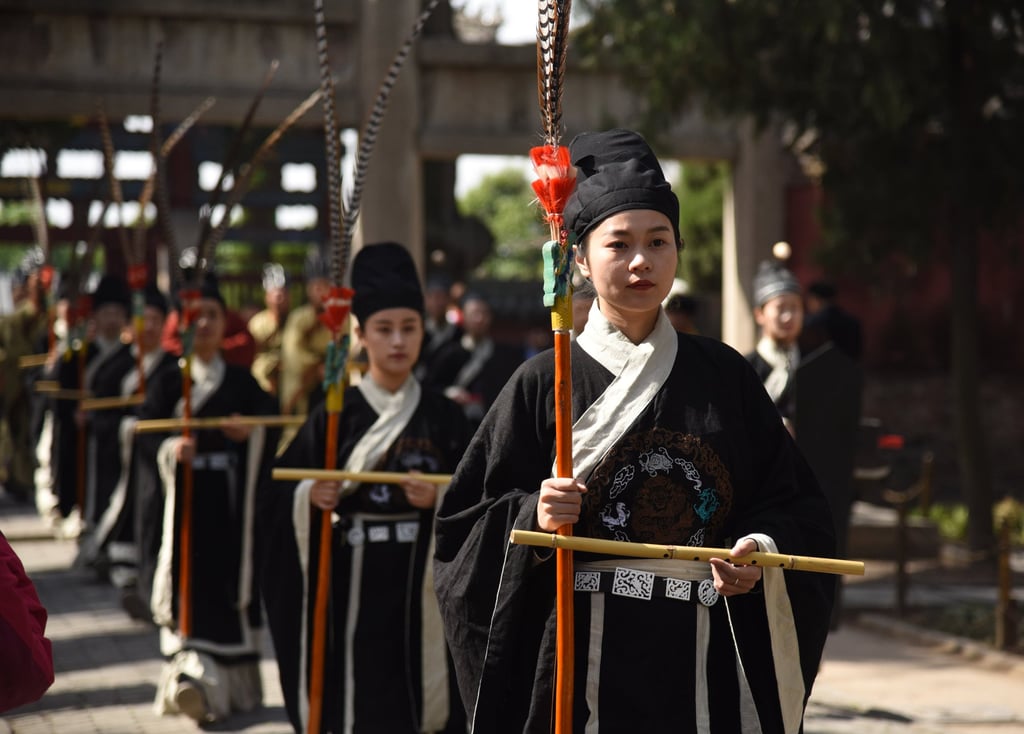
People perform a commemoration ceremony for ancient Chinese philosopher Mencius and Mencius’ mother, in Zoucheng, Shandong province, on May 6, 2019. Photo: Xinhua
These ideological alignments are no historical accident. The American founders were children of the European Enlightenment – a movement that was deeply, unabashedly infatuated with China. During the 17th and 18th centuries, a massive wave of “Sinophilia” swept across Europe. Philosophers desperately seeking to reform societies fractured by religious warfare, monarchical corruption and clerical dogma looked to the East. As detailed accounts from Jesuit missionaries flooded the continent, Enlightenment thinkers weaponised Chinese philosophy as a blueprint for a rational, secular civilisation.
Voltaire was so captivated by these ideas that his writing desk, still preserved in the Paris Museum, was ornately decorated with Chinese landscapes. He viewed Confucianism as the purest expression of Deism – a belief in a rational creator grounded in human ethics and reason rather than divine revelation or the threat of eternal damnation. Similarly, Francois Quesnay, the leader of the French Physiocrats and a foundational mentor to Adam Smith, was so famously obsessed with Chinese governance that he was nicknamed the “Confucius of Europe”. Quesnay looked directly to the Daoist concept of Wuwei (action through inaction) as he formulated the economic doctrine of laissez-faire capitalism.
However, by the late 18th century, Europe’s intellectual romance with China began to curdle. The onset of the Industrial Revolution granted Western powers unprecedented military and technological dominance. A new generation of thinkers, typified by Georg Wilhelm Friedrich Hegel, began rewriting global history. China was abruptly reframed – no longer an enlightened utopia of merit and reason, but a stagnant, frozen pool of “Oriental despotism”.
From that pivotal moment onwards, the West adopted the posture of a stern schoolmaster, attempting to reform China through trade, diplomacy or gunboat warfare. China’s foundational contributions to the Enlightenment were systematically minimised, forgotten and buried under a narrative of Western exceptionalism.
Admittedly, the early views held by Voltaire, Quesnay and Franklin were somewhat romanticised – but no more so than contemporary idealisations of the Magna Carta or Athenian democracy. By the time of the First Opium War in 1839, internal decay and centuries of self-imposed isolation had indeed left China vulnerable and corrupt. The myth of absolute Western cultural superiority became so pervasive that generations of Chinese intellectuals accepted it wholesale, leading to radical 20th-century movements aimed at completely eradicating traditional Chinese heritage.
Today, however, the pendulum is swinging back. Scholars and citizens are beginning to recognise the folly of completely dismissing a centuries-old civilisation. As the US approaches its historic 250th anniversary, there is a timely opportunity for thinkers on both sides of the Pacific to unearth these forgotten intellectual roots. By looking past modern political theatre and recognising the shared philosophical DNA that built the modern world, the oldest surviving and newest superpowers might finally foster a relationship rooted in genuine mutual respect.
Chow Chung-yan began his journalistic career at the South China Morning Post and rose to become Editor-in-Chief in 2025. He has been running the SCMP’s day-to-day news
]]>Donhttp://dontow.com<![CDATA[July 2026 Update on US-China Relationship]]>https://www.dontow.com/?p=96072026-07-10T02:53:02Z2026-07-09T04:15:00ZWith Trump in his second term as the President of the U.S., he has taken many actions that may be questionable from a legal perspective. Even if they are legal, they are definitely not for the benefits of the whole country, but only for the Republican Party and often for the benefits of Trump and his family.
Trump has manifested in his second term as the worst of himself. Not only that he is not serving as the President of the whole nation, he has manifested himself as the president of the Republican Party, and more specifically as the head of that part of the Republican Party that aligns fully with themselves and not the party representing the whole country. He has abandoned those who are not wealthy, he has abandoned those who are not as well established financially or as healthy or compensated by health insurance including government established health insurance. He has reduced funding for the SNAP (Supplemental Nutrition Assistance Program, formerly known as Food Stamps) and for the Afforded Care Act (ACA), the comprehensive healthcare reform that was signed into law by President Barack Obama in March 2010. and commonly referred to as Obamacare.
His policies benefit the rich and those who can support themselves if they are faced with medical problems. He has abandoned the majority of the people who are not among the country’s wealthy class, he has diminished those government policies that can help the country’s poorer classes.
I think that there are two general policies that govern Trump’s presidency, especially his second term. He knows that the policies he plans to implement will not be popular, perhaps resulting in a lot of unrest. He wanted to have his military police under him to handle the public unrest. Since normally the police is under the state or local governments, he wanted his own police under his control. That was why he wanted the ICE (Immigration and Customs Enforcement) to serve as his military police.
Secondly, he also knows his policies may be very unpopular and he may not be rated highly and knows that he may not have a lot of followers under his party and that is why he is creating the ground work for questioning various voting results. He also knows that he can unleash his conservative ultra rightish click of followers who tried to rise up to overthrow the 2020 presidential election. Many of these followers were arrested and sentenced to prison, but Trump pardoned them, and he may reuse them in the future. He is preparing to overrule whatever election results will turn out in the future. He is more than a dictator who plans to overthrow whatever popular voting will turn out.
This is Trump’s one two punch: (1) Military police with ICE under his control, and (2) preparing to question and overthrow popular elections using whatever means necessary.
]]>Donhttp://dontow.com<![CDATA[July 2026 Update on Recovering on My Stroke]]>https://www.dontow.com/?p=96162026-08-28T02:33:32Z2026-07-09T04:05:00ZIn my last update I provided in early part of June 2026, now i want to provide an update around July 10, 2026. There are two major issues. One is that in the last several weeks, i have lost my appetite. The second issue is that in the last several months, because of my lack of consistent training, i can no longer do my Taiji forms (e.g, the Yang Style Taiji 24 Form) properly.
First, let me discuss the first issue. After discussing with my primary physician Dr. Xu. She prescribed a medicine Megestrol Acetate 40 Mg taken twice a day that hopefully may increase my appetite (although. Dr. Xu already warmed me that that medicine may not do the trick). It is too early to determine whether that medicine would do the trick. Since it is not doing any harm, I will continue with that medicine. Related to the first issue is my self imposed restriction on my diet, e.g., no orange juice and no ice cream, which I found might have contributed to my loss of appetite. So I decided to remove that restriction and see whether my appetite may return. We should know in the next few weeks.
The second issue is that I can no longer stay steady when doing my Taiji forms. For example, I want to practice doing the Yang Style Taiji 24 Form, which I used to be able to do. However, because I haven’t practiced it for several months, I can no longer do it with a steady pace. I have a tendency to be unable to keep my feet and hands steady and in a position to keep my feet and hands oriented in a particular manner to maximize the rotation of the hip (and therefore maximize the power from the forms I am doing). Hopefully with consistent practice, I can recover my previous steadiness. This will just take more and more practice; so time will tell.
]]>Donhttp://dontow.com<![CDATA[New Update On President Trump, and U.S.-China Relationship]]>https://www.dontow.com/?p=94402026-06-15T02:39:56Z2026-06-08T14:05:11ZIn the last issue I wrote even though you could see the shortcomings in his first term as the President of the U.S., these shortcomings became so obvious in his second term that you have to be blind not to notice them. President Trump failed miserably to lead the U.S. in many important categories:
price increases
job losses
decline in the job market
domestic peace
world peace
reputation of the U.S. as the premier country in the world
What is especially sad is that President Trump and his whole administration’s assessment of the U.S and the world around him is constantly changing. Because of this, you cannot argue with him, because he never has a real position. His arguments are not based on facts or normal logic. He considers only positions that are only similar to his. He cares so much on what can enrich him and his family. He doesn’t care about you when you don’t see things the way he sees things. He ignores the world around him, and retreats from important world pursuits such as the 2025 Paris Agreement on Climate Change, even doing otherwise could lead to a non-survivable world.
Basically he is running the U.S. based on his own wishes, and on those wishes he is also trying to run the world. He is trying to run the U.S. without a well-thought-out plan with the support from other Americans. Sooner or later, his plan will fail, and it will be up to the rest of America to bail out his plan.
This was what I wrote earlier this year, after he has been in office for about a year in his second term. The situation has gotten significantly worse. On February 28, 2026, Trump started a major war against Iran, which has continued to today, This included the assassination of many of the Iranian leadership. This war has resulted in the closure of the Strait of Hormuz and resulted in large increases in gasoline prizes.
Trump doesn’t have a plan for this war, and doesn’t consult with other leaders, and tries to run the country and the world with his thoughts from the top of his head at that moment. He and his family are enriching themselves. He is constantly criticizing those with opinions which are not similar to his. He doesn’t take into consideration the thoughts of others, especially the thoughts of others whose opinions are not similar to his. This is clearly seen by the rest of the country and the world. That is why his approval ratings by Americans have fallen to the lowest point, but he continues in the same way. Unfortunately we have to suffer the consequences. For these reasons, the reputation of the U.S. has fallen significantly during the year and a half of President Trump’s second term as the President of the U.S.
Trump has also filed a $10B lawsuit against the U.S.’s Internal Revenue Service. In a recent announcement, Trump may settle his lawsuit against IRS by agreeing to a $1.8B fund to compensate his allies, possibly including those who rioted against the U.S. government in 2021. It is unclear what will be the outcome of this lawsuit and settlement. But it has raised many red flags, and it may undergo many changes. Trump may also be able to keep the IRS from auditing his past taxes.
Now I want to discuss U.S.-China relationship. But we must first remind ourselves of the history of modern China, especially the history within the last 200 years. Within this past century, China has revolutionized the country. Unlike the poor impoverized country of the mid-19th century that was picked on as the sick man of Asia by other countries of the world, China has stood up. It has basically eliminated poverty for the country as a whole, and has significantly raised the standard of living for the whole country. It has almost become the world’s factory and is the world’s second largest economy. It has also become the leader in the world in many categories, such as patents, university rankings, and college student assessment. For example, the US News Best Global Universities rankings show that Chinese universities are in the world’s top ten in 22 subject areas, including materials science and engineering. The results of the Programme for International Student Assessment (PISA) indicate that Chinese students consistently maintain a position in the global top three in the core competency assessments of reading, mathematics, and science. Furthermore, China has become the world’s second most powerful country, just behind the U.S.
However, many people in the U.S., including many politicians, have a lot of negative thoughts about China. Either these came from their previous thoughts and impressions. They think of the old China and think of all the bad things that can happen in China; they think of the lack of freedom in a communist China. They think of all the previous treaties that were imposed on China, independent of whether these treaties were right or justified. They think that the people in China must not be happy.
But recent international surveys showed that the happiness of people in the Chinese mainland has largely increased in recent years, with one of the survey reports suggesting that Chinese people are among the happiest in the world. The Global Happiness 2023 Report, released by multinational market research and consulting firm Ipsos (ref.1) ahead of the International Day of Happiness on March 20, in 2023, showed that Chinese people are the happiest among the 32 countries and regions sampled, with 91 percent of Chinese respondents saying they are generally happy, 12 percent increase from a decade ago. The analogous data in the U.S. shows that the happiness index was rated at 76% in 2023, with a minus 7% decrease in the last 10 years.
Although one may not believe in the absolute accuracy of these specific market research data, there is no doubt that market research data do show that people living in Mainland China are generally happy and not living miserably. This is not to deny that there may also be problems in China.
So there seems to be a disconnect between reality and what many Americans and politicians think of Mainland China and Taiwan. To address this issue, first, people need to know the history of China, and understand that Taiwan has always been a part of China. If it weren’t for the intervention of the U.S., Taiwan would have been part of China since 1949 or 1950, and there would be no question whatsoever about the independence of Taiwan.
They need to understand that their impressions of China are outdated and wrong, and sometimes purposedly misrepresented by our government and the mass media. Why do U.S politicians have such feelings and allegiance toward Taiwan? First, it is related to our sometimes purposedly misinterpretation of history, sometimes to some twisting of history so that it is closer to what we want, and sometimes to outright ambition to get what we want. It is true that Taiwan currently produces the world’s best semiconductors and chips. People should just acknowledge that as a fact, instead of trying to become partial owners of that, It is time for the U.S. to wake up from reality and face the world.
Why sell massive arms to Taiwan to defend Taiwan from China? If you know the history of China, there is no reason for that at all. Furthermore, that could lead to the destruction of Taiwan and the deaths of millions of Chinese in Taiwan and Mainland China.
We should stop the continued interference on the internal affairs of China. Let China be China and work collaboratively with China to improve the welfare of humankind.
————————————-
References
According to the March 29, 2023 international market research ipsos report, Chinese people are the happiest in the world. Although some people may not be aware of the organization lpsos, it is actually a large French (headquartered in Paris) world-wide organization that has done many surveys of public opinions in the U.S. and the world. As a matter of fact, lpsos often uses general market research data produced from the gallup poll.
]]>Donhttp://dontow.com<![CDATA[June 2026 Update on Recovering from My Stroke]]>https://www.dontow.com/?p=94942026-06-08T14:23:09Z2026-06-08T04:15:00ZThis article provides the latest update on recovering from my stroke. On September 16, 2023, I. suffered a minor stroke early that morning when I tried to get up. Something didn’t seem right, although finally I was able to get up. Since that was a Saturday, after breakfast, I went as usual to the Taiji class that I taught at Marlboro Fidelity Chinese School. But during my Taiji class, something didn’t seem right, after I came home and after lunch, I went to the Riverview Hospital. A brain MRI did show that I had a minor stroke, and images of other possibly transient strokes in previous years.
On and of, I did physical therapy (PT) for several months. During the next 2-3 years, I also had acupuncture done many times, but I never had it done during the first month when acupuncture could have been more effective (because I didn’t have that knowledge at that time). Up to now, I still feel the consequences of that stroke, and I have been trying to recover from that stroke. Previous articles in my website have mentioned about my recovery, and this article is a continuation of those articles.
Because of my many activities (including writing the book “The Yin and Yang of the Dragon and the Eagle: Tale of Two Cultures and Two Countries” which came out in April 2026, I have been very busy, and didn’t have too much time to do the exercises that could help in the recovery process. Hopefully now I can spend more time doing these exercises, although I am still working on the Chinese version of that book, which is taking up too much of my time because the publisher has made all kinds of mistakes.
In the coming quarter (June- August 2026), I plan to spend more time doing the various exercises (including the PT exercises) to improve my health. I still have not make much progress in gaining back my lost weight (since July 2025), partially due to not being able to gain back my appetite. However, I have been seeing my various doctors on a regular basis, and their exams and tests all show normal and in good health. Part of my next goal is to gain back some of my lost weight, and to improve my physical flexibility and strength. Nevertheless, I think my health is not the same as before, with respect to stability, and my strength. On my health, I will have to wait to find out what the future will be like.
I also plan to go back and do my Taiji on a regular basis, in particular, focusing on the Yang style Taiji 24 Form, especially paying attention to the first 10 forms that emphasize the small movements (or shifting of weights to the feet and body) to improve the strength as well as the stability of Taiji.
]]>Donhttp://dontow.com<![CDATA[Book Reviews of “The Yin and Yang Of the Dragon and the Eagle: Tale of Two Cultures and Two Countries”]]>https://www.dontow.com/?p=94892026-06-12T03:33:47Z2026-06-08T00:25:14ZMy book “The Yin and Yang of the Dragon and the Eagle: Tale of Two Cultures and Two Countries” was recently published. This article includes several reviews of that book:
Lillian Sing: A retired judge from the state of California, who co-founded “Rape of Nanking Redress Coalition” and a dedicated Equality and Human Rights Activist. She has received numerous judicial and legal awards, including “Trial Judge of the Year Award by the San Francisco Trial Lawyers Association” and “Outstanding Jurist Award” by the San Francisco Women Lawyers Alliance.” She resides in San Francisco.
Julie Tang: A retired San Francisco Supervisor Court Judge, covering a wide range of cases, including Civil, Criminal, Family, Juvenile Delinquency, and Dependencycases, who is also a long-time activist who co-founded “Rape of Nanking Redress Coalition” and “Pivot To Peace.” She resides in San Francisco.
Ying-Ying Chang: A biochemist who taught and conducted research at the University of Illinois, and authored the book The Woman Who Could Not Forget. She and her late husband Shau-Jin Chang co-founded the Iris Chang Memorial Fund to honor their beloved daughter Iris Chang who wrote the international best seller The Rape of Nanking. She now resides in San Jose, CA.
We welcome other readers to write their review of this book. Besides my website, they can submit their book reviews to sources like Amazon.com, Barnes & Noble (B&N), newspapers (e.g., local newspapers, or Sing Tao Daily, or South China Morning Post), or magazines.
Reviewer: Lillian Sing
Don M. Tow’s “Tale of Two Cultures and Two Countries” is a compelling and deeply human work—one that I found impossible to put down. What makes it extraordinary is Tow’s ability to filter seven centuries of world history through the intimate lens of his own family’s journey. Rather than offering a detached chronology, he weaves global events—wars, diplomatic shifts, cultural tensions—into the lived experiences of his parents, his own upbringing, and the communities that shaped him. This personal grounding transforms historical fact into narrative truth, making the past feel immediate, urgent, and profoundly relatable.
As someone who knows the author, I connect deeply with his family stories and cultural reflections he shares. Yet even readers unfamiliar with his world will find history not only accessible but gripping. Tow’s storytelling makes complex events understandable without ever oversimplifying them.
Dr. Tow provides a clear and insightful account of the worldwide Diaoyu Islands movement and the student activism that galvanized a generation. He also confronts the horrific “comfort women” system—the forced sexual enslavement of hundreds of thousands of women and girls by the Imperial Japanese military—with accuracy, dignity, and moral clarity.
As a retired judge in California, I particularly appreciated Tow’s careful distinction between governmentlevel war reparations and victim-centered damage compensation. This legal nuance is essential to any meaningful pursuit of justice. Tow also honors individuals such as Tamaki Matsuoka, often called the “Conscience of Japan”, and Tong Zeng, known as “The One who speaks for the Voiceless.” Both of whom have dedicated their lives to giving voice to survivors and preserving historical truth.
Tow’s book is especially timely as 2026 marks the 95th anniversary of the start of the Second SinoJapanese War (1931–1945), a devastating conflict that claimed an estimated 25–30 million Chinese civilian lives and left a legacy of widespread sexual violence and unimaginable suffering. Tow recounts these atrocities with precision and compassion, grounding them not only in historical record but also in memories passed down through his own family. That personal link turns statistics into human pain—and human pain into a call to remember.
Tale ofTwo Cultures and Two Countries is a powerful appeal for peace. By illuminating war’s human cost through the story of one family, Tow reminds us that understanding the past is the only path to preventing future atrocities. This book should be read by every student and belongs in every library. I highly recommend this book.
Reviewer Julie Tang
“The Tale of Two Cultures and Two Countries“ is an easy read and a must-read for anyone curious about their next-door immigrant. But the author, Don Tow, is not exactly a typical immigrant. He has much stronger American roots than most immigrants. His paternal grandfather had lived in the US, and his maternal grandfather was born in the US before Don was born. Years later, Don returned to the US as an immigrant child to immerse himself in the land of the U.S.
I couldn’t put the book down once I started. Every page has a story that, as a fellow Chinese immigrant from Hong Kong, I could identify with and relate to from my own experience, like a mirror held up to my own life.
This book is about history. And not just Don’s own family history, but also the geopolitical framework of wars and social upheavals that envelop Don’s immigrant story, helping to make sense of how WWII in Asia affected people’s lives. Don’s life exemplifies much of what Chinese immigrants who had gone through the traumas of wars in the last half-century faced in the US. They escaped the indescribable cruelty visited upon China during the Japanese invasion of China, and survived the dangers of civil war and domestic turmoil that followed. They found respite in the US. And overcome the language and cultural adjustments. As Don matured and integrated into the mainstream US, we learned that the process by which immigrants came to understand themselves and the country they adopted had transformed them into the dragon and the eagle, providing the real respite for the immigrant soul. Often the debate falls on whether an immigrant should be totally “American” or keep true to their own ethnic heritage and culture. This book provided an answer. You can be both. But it’s a lot of work to get there.
Chapter 19 is a high point in this book. I was in college at the time of the Diaoyu Island incident. Don did an excellent job of explaining the basis of the controversy, relying on history, geography, and the law.
The Daioyu Island incident ignited a flame of moral outrage among the Chinese people worldwide. The incident raises an existential question: Japan lost the war in WWII. But why is it allowed to continue to take land from its victims? To this date, the Daioyu Island remains an unresolved post-WWII issue.
Don’s search for his inner self includes a path to the Taiji doctrine and exercises through which he found the yin-yang formula to flow with the energy of the dragon and the eagle. The energy became wholly interdependent and integrated. I hope more people will be inspired to take up this gentle exercise after reading Don’s lectures on Taiji. You may find your inner dragon and eagle also.
I highly recommend this book to anyone interested in learning about WWII history in Asia and how one immigrant family navigated the travails of war and upheaval, finding a home in the US. This is a story of all immigrants, from the Mayflower to the modern day. It is an inspiration for more immigrants to write about their own stories and for other immigrants to be welcomed here in the US.
Reviewer Ying-Ying Chang
Author Don M. Tow, as well as I, belong to the same generation; therefore, his memoir deeply resonates with my own memories and experiences.
Born in the 1940s, we shared many of the same historical experiences, including the Japanese invasion of China in the 1930s and the civil war between the Nationalists and Communists in the 1940s. In the book, Don describes how the Tow family was forced to move repeatedly as refugees because of war — from Guangdong Province to Hong Kong, back and forth several times, and eventually immigrating to the United States. Many of these experiences felt like déjà vu to me.
Don’s father was educated at Massachusetts Institute of Technology as a civil engineer. However, because of war and political turmoil, he was never fully able to devote his talents to helping build the country he loved. Like countless others of that era, much of his potential was consumed by the conflicts of war.
At the age of 13, Don immigrated to the United States with his parents and settled in the small California town of Placerville, which at the time had a population of only about 3,000. His parents abandoned their roots in Hong Kong and took enormous risks in search of a better future for their children. Their sacrifices ultimately paid off: all five surviving children received excellent educations, earning college degrees and some Ph.D. Their story is a remarkable example of perseverance, courage, and the pursuit of the American dream.
In his memoir, Don vividly recounts his years as both an undergraduate and graduate student at University of California, Berkeley during the turbulent 1960s. He witnessed and participated in some of the most significant student movements of the twentieth century, including the Free Speech Movement and the Anti–Vietnam War Movement.
Among these, the most important to him was the worldwide Diaoyu Islands student movement, in which he was personally involved. The Diaoyu Islands had historically been considered part of China’s territory since the Ming Dynasty. However, after World War II, the United States transferred administrative control of the islands to Japan despite the Cairo and Potsdam Declarations, which stated that territories occupied by Japan should be returned to China. This decision sparked strong protests among Chinese communities worldwide, who viewed it as a grave injustice. The student movement profoundly influenced both China and Taiwan and continues to affect the geopolitics of China–U.S. relations today.
Originally trained as a physicist, Don first pursued an academic career before moving into industry. Yet his interests extended far beyond science. He became an advocate of Tai Chi and a soccer coach, demonstrating a lifelong commitment to both physical and intellectual pursuits.
After retirement, Don devoted much of his energy to social justice causes, particularly seeking justice for survivors of the Sino–Japanese War of the 1930s and 1940s. He tirelessly educated the public about Japanese aggression in China from 1931 to 1945 by leading school teachers and researchers on educational trips to China. He also maintained a website discussing contemporary world political affairs.
Spanning two countries and two cultures, Don’s life has been extraordinarily rich, dynamic, and multifaceted. His memoir offers readers not only fascinating personal stories, but also valuable historical insights and wisdom drawn from a lifetime of experience. Readers will find this memoir both enlightening and inspiring.
Info about the Book
Available in book stores like Barnes & Noble (B&N) and Amazom.com:
Paperback: $18.99
Hardcover: $28.99 at B&N and other book stores. But $40.99 at Amazon.com
Ebook: $8.99
]]>Donhttp://dontow.com<![CDATA[March 2026 Update on Recovering from My Stroke]]>https://www.dontow.com/?p=94252026-05-29T04:18:48Z2026-03-14T16:19:55ZThis article provides the latest update on recovering from my stroke (that occurred in September 2023).
First, I want to mention that in July 2025 I had pneumonia and lost about 15 pounds. The lost of weight, together with my loss of appetite, had stopped in the first week or so, and since then I had maintained my weight at the reduced weight. I have since then gained back 2-3 pounds, and hoping to gain a few more pounds in the next 2-3 months.
I have also been doing physical therapy (PT) about two times per week at “Bell Wellness” which is located in the complex “Bell Works” (which took over the former Bell Labs location). This is a very convenient location, since it is only a few hundred yards from my home. Within the last month, I have also been engaged in a few wellness exercises at the “Fitness Factory,” which is also inside the “Bell Works” facility.
At the Fitness Factory, I am also working with weights to build back my strength and with walking (either inside Bell Works or later outside when the temperature is warmer). I also have a threadmill at home which I can use and practice together with other exercises like Taiji. I do notice that my overall health had declined, in the sense that after 15-30 minutes of exercise, I would feel tired and need to take a break.
With my PT and with other exercises, I hope I can keep my health from additional deteriation. I am hoping that in the next 2-3 months, I will regain part of my appetite, gain a few more pounds, and gain back my stamina. At least that is my hope. Of course, nature and aging will desire what will be the outcome.
In the meantime I will continue to do my PT and my exercises, including more walking. I plan to resume doing more Taiji. Hopefully I can stall the delay of aging.
]]>Donhttp://dontow.com<![CDATA[Excerpts from My Book: The Yin and Yang of the Dragon and the Eagle: Tale of Two Cultures and Two Countries]]>https://www.dontow.com/?p=93622026-03-14T16:16:30Z2026-03-14T16:16:30ZI have been involved in many extracurricular activities throughout my adult life. My book The Yin and Yang of the Dragon and the Eagle: Tale of Two Cultures and Two Countries recollects about my life, as well as the lives of many of my relatives as dragons and eagles. At the same time, the book also discusses many of those extracurricular activities during the six-plus-decades of my adult life.
One can learn many things during those activities. This article contains excerpts from my book about many of those activities.
At the end of this article, the Table of Contents of my book will be included.
“Incident Happening in Hong Kong on “No Men’s Land” on Christmas Eve 1941″
This incident happened on Christmas Eve 1941, just before the Japanese army entered Hong Kong and took control of the city, and after the British army and the Hong Kong police had basically ended their responsibility of providing public security and safety on the streets of Hong Kong. On that evening, Hong Kong was known as “No Man’s Land,” when the streets were under the control of undesirables knocking on doors who tried to extract money from the ordinary people. This incident happened to our larger family in Hong Kong.
The undesirable gang leader took control of our apartment and seized the oldest man in that apartment, who was my father’s older brother, and told his gang “Take him outside and shoot him unless he gives us money.” We (especially my aunt were very concerned on hearing that comment). But before that action can be taking, my father told the gang leader to negotiate with him. After a couple of minutes of negotiation, my father handed him some money, American money which my father still carried occasionally from his earlier life living in the U.S., they left our apartment and that ended that incident.
Any person who wants to learn more on this incident can do so by reading Chap. 8 “No Man’s Land in Hong Kong.”
Interview of my father and grandfather at the Immigration Office on August 15, 1921
After my father took the trans Pacific voyage to the U.S. as a merchant’s son, he had to undergo an interrogation at the U.S. immigration office in Waltham, Massachusetts. During that interrogation, my father was asked 38 questions. A Brown University Asian Studies researcher retrieved the interrogation transcript for us from the National Archives Office in Waltham, Massachusetts. The inspectors asked many detailed questions, making it very difficult for a fake applicant to pass and very easy even for an honest applicant to fail. They asked questions such as: How many houses in your row on the street where you lived, is there any building opposite to your small door, who lives opposite your large door, how many houses in the 4th row, who lives in the 5th house in the 4th row, who lives in the 7th house in the 4th row, where did you get your drinking water? (The immigration office personnel got such information from other papers of other applicants, keeping in mind that at that time many of the Chinese immigrants came from that part of China, Taishan).
On the same day in a separate meeting with my grandfather, they asked 45 questions, with many similar questions. Any discrepancy between my father’s answers and my grandfather’s answers was grounds for rejection.
Any person who wants to learn more on the interrogation of my father and grandfather can do so by reading Chap. 2 “The Saga of My Father’s First Journey to the U.S.”
Grammar School Punishment in Hong Kongin 1950
When I was in 3rd grade in Hong Kong,, I forgot to bring my notebook to school. My punishment at school was to write 1,000 times the Chinese word “dig” which was the most difficult word to write in Chinese (鑿), although it is not the Chinese word with the most number of strokes. It takes about one minute to write this Chinese word once even if you write this Chinese word very fast. I don’t question the punishment, but I do question that type of punishment, when it was a harmless mistake that did not affect anyone else. Although I disagreed completely on that punishment, I have to acknowledge that I never forgot to bring my notebook again.
Any person who wants to learn more about this incident can do so by reading Chap. 13 “Reminiscenses of Early Childhood in Hong Kong.”
My 8-year old sister retrieving water while living in 2nd floor apartment in Taishan village during WWII
My 8-year-old sister Billie had to retrieve water from a nearby river on a daily basis to support the living necessity of our family when we were living in our 2nd floor apartment with no running water in our Taishan village during WWII . She had to do this on a daily basis by carrying a bamboo pole with a bucket of water at either end of the bamboo pole for several months.
Any person who wants to learn more on this incident can do by reading Chap. 10 “Escape from No Man’s Land in Hong Kong to Taishan, China.”
Mother winning the 50 meter dash several feet ahead of the 2nd place finisher at county track meet
My mother winning the 50 meter dash at the county track meet several feet ahead of the 2nd place finisher in this short track meet in her Zhongshan city. The distance of winning by several feet was very unusual for this short race of only 50 meters, when the usual finish was usually separated by inches (see photo).
Any person who wants to learn more about this incident can do so by reading Chap. 3 “Tale of My Mother and Her Family’s Origin.”
Seeing the Golden Gate Bridge after crossing the Pacific Ocean
This scene of seeing the beautiful Golden Gate Bridge was most memorable in our lives as our ocean crossing ship was near our journey of beginning our lives as Eagles on 10/27/1955 (see Chap. 15 for the picture of the Golden Gate Bridge and our rental house in Placerville). We were met in San Francisco by our father’s college roommate Mr. Harold S. Prescott. That was the beginning of our lives as Eagles.
Any person who wants to learn more on that incident can read Chap. 15 “Pulling Up Roots One More Time-Hong Kong to U.S.A.”
Fluctuation in Chinese currency in our Taishan village during WWII
During times of war, money fluctuated greatly. Sometimes our father was paid by pounds of rice when he taught high school in our Taishan village during WWII around 1944.
Any person who wants to learn more on this incident can do so by reading Chap. 11 “Victory from War-Return from Taishan to Guangzhou.”
Our first house in Placerville, CA in the winter of 1955-56
My father’s college dormitory roommate Mr. Harold Prescott rented an inexpensive house for us when we arrived in Placerville, CA in Oct. 1955. Mr. Prescott found an inexpensive house ($35/month) that is close to their house and within walking distance to their office. It was an excellent location and affordable, but it had its problems. That house had many leaks. When it rains, there were as many as two dozen leaks on the roof, and there were many bugs and slimy slugs inside our house from various holes and cracks from the sides and floors of the house. On a rainy day we had as many as 2 dozen cans inside the house catching roof leaks. Furthermore, on a cold, winter day, the water pipe in the kitchen was frozen until late morning when the external water pipe was warmed by the sun and the frozen ice thawed. At that time the frozen ice allows it expand along the pipe and didn’t crack the pipe.
Any person who wants to learn more on this incident can do so by reading Chap. 15 “Pulling Up Roots One More Time-Hong Kong to U.S.A.”
Some Early Observations of Discrimination in the U.S.
While growing up in Placerville, we were not discriminated against. However, we did observe discriminations in our high school when starting in my sophomore or junior year, a small number of black students started attending our high school. When they were in our school corridors where our lockers were, they would have their books knocked out of their arms by other students for no reason at all. I saw this happening many times. It was no use for them to complain the school, because they knew nothing significant would be done, except for a comment or two by the school authorities to the students that they should not do that again. But everyone knew that no real punishment would be taken against the offending students. This, of course, would not be allowable today, but in the late 1950s, this was represented of the racism exhibited against America’s black students.
During two summers when I worked at the Forest Service in Placerville, we were members of the engineering crew doing surveying on roads that would be built for lumber roads in the El Dorado National Forest. Our engineering crews of about half a dozen young men per crew would leave our Placerville office early on Monday morning and return on late Friday afternoon, and we would live overnight in trailers during the weekdays. Our crew of young men would chit-chat and drink beer every evening after dinner, until many of them were dead drunk by the time they went to bed. Since they drank so much beer and were drunk, they would pee all over their sleeping bags during the night. So, on many mornings, we would see several sleeping bags hung up on clothes lines around our trailers for drying. I just do not understand why such young men would spend so much of their time on such unproductive and unhealthy activities.
There is another incident related to our young engineering crew. One summer, we had a college student who was a foreign student from Iran working on our crew. Our American crew members would call him using all kinds of derogatory names, such as camel jockeys. And one night, they sneaked a non-poisonous snake into his sleeping bag in his trailer. Again, I do not understand why any person would do such nasty things to another person.
Anyone who wants to read more on these incidents can do so by reading Chapter 16 “Early Experiences in U.S.-Start of Tale of Two Cultures and Two Countries.”
What Triggered the Free Speech Movement at UC Berkeley in 1964
The University of California at Berkeley started the Free Speech Movement (FSM) in 1964. This movement triggered many similar free speech movements across many college campuses around that time. What triggered these movements at that time?
As difficult as it may be to believe, a lot of the freedom of speech activities that we now take for granted were actually not allowed on many college campuses in the U.S. about 60 years ago. Activities, such as advocacy for civil rights causes, recruitment of people to support off-campus activities like voter registration drives or religious missionary work, or solicitation of donations to combat hunger, are taken for granted by today’s college students everywhere in the U.S. However, in the fall of 1964, they were all forbidden activities at the University of California (UC) at Berkeley and many other college campuses in the U.S. At that time, students on campus could discuss these activities intellectually, but they were forbidden to advocate actions to support causes, no matter how noble those causes were.
That was the reason why students at UC Berkeley in the fall of 1964 started the Free Speech Movement (FSM) and triggered a new generation of student activism across the campuses of America. It is important to note that the initial protest had support from students across the political spectrum, not just the radical left, but also young democrats, young republicans, and religious organizations, as you can see from the dress attire of the protesters in the attached photo. Therefore, student activism in the 1960s helped to restore speech freedom guaranteed by the U.S. Constitution.
Anyone who wants to read more on these activities can do so in Chapter 17 “Ten Years at Berkeley in the Turbulent 1960s Decade.”
Friend who went back to Hong Kong to start a free junior high school in remote fishing village of Tai O
A closed friend before finishing his Masters Degree in electrical engineering at UC Berkeley went back to Hong Kong to start a free junior high school in Tao O. He abandoned a bright future to offer the less fortunate the opportunity to continue education in Hong Kong. He and collaborators not only helped these less fortunate young people with continued education, but they also established temporary odd jobs to help their families financially.
Anyone who wants to read more on these activities can do so in Chapter 20 “The Shaping of the Life of a Fellow Student at UC Berkeley.”
Lessons Learned from My First College Teaching
When I taught first year physics at the University of Texas at Austin in the fall of 1977, I wanted to use the model I learned while taken similar courses at UC Berkeley in late 1961. At UC Berkeley It was a large class with 250 students with physics and engineering majors. At Texas it was also a large class with about 100 Engineering students (the physics students took a separate course). I planned the exam with an average of 40 or 50 with the highest grade in the 80s or 90s, and the lowest grade in the 20s or 30s. To my great surprise, the class average was only 19, although the highest score was in the high 70s, with many scores in the tens.
Right after that test, I could sense that the morale of the students in my course had dropped significantly. I thought very hard about what had happened. Even though I adjusted in my subsequent midterms when the class average was raised to the high 40s or low 50s, the damage to my students’ morale and interest was already done. I can sense that it is no longer the same as before, even though the students did not tell me so. Although I could figure out the reason for the significant drop in the score. Whatever the reason was, I learned the hard way in my first year of teaching. You have to teach and design the difficulty of your exams to match the type of students expected to be in your class. Otherwise, the students can be demoralized, and the interest and motivation they have for the course can quickly disappear. Unfortunately, I did not learn that lesson until it was too late.
Anyone who wants to read more on these activities can do so in Chapter 23 “Lessons from My First Year College Teaching.”
Lessons Learned from the Worldwide Diaoyu Islands Student Movement
We had discussed that the Diaoyu Islands belong to China, as part of the Taiwan Province. What changed n the 1950s? The case was very clear, and there shouldn’t have been any question about which country should have sovereignty over the Diaoyu Islands. However, the international political environment changed with the establishment of the People’s Republic of China (PRC) after the Chinese Communist Party won the civil war over the Chinese Kuomintang Party. If it weren’t for the military support of the U.S. for Chiang Kai-shek’s government in Taiwan, Taiwan would have been united with the rest of China. All of a sudden, China, instead of being an ally of the U.S., is now viewed as an archenemy that needs to be weakened, isolated, and plotted against. On the other hand, Japan, the country that bombed Pearl Harbor in a surprise attack and committed massive, unimaginable, inhumane atrocities in China and all over Asia, is now considered an ally of the U.S. to plot against China.
Therefore, as early as 1951, it was already fairly clear about the imperialistic intention of the U.S. toward China and their planting the seed to ally with Japan to cheat, contain, and weaken China. In 1970, the U.S. and Japan were planning for the transfer to Japan of the administrative control of the territory of the Ryukyu Islands, which, since the 1953 unilateral decision of the U.S., included the Diaoyu Islands. Both the PRC and the ROC objected to this agreement and argued that this agreement did not determine the sovereignty of the Diaoyu Islands. To the people who do not understand the historical Diaoyu Islands, this unilateral decision of the U.S. created some confusion why the U.S.’ Mutual Defense Treaty with Japan should be applicable to the Diaoyu Islands.
Anyone who wants to read more on these activities can do so in Chapter 19 “Experiencing the Worldwide Diaoyu Islands Student Movement.”
Lessons Learned from the Experience of Working in the Industry
Being an academic in the college environment, in 1980 when I switched to working in the industry by going to AT&T Bell Labs to work opened my eyes to the industrial world. I learned the interplay of academic research and the business world of making a profit. There were many things I learned and experienced in the industrial world, in this book I just want to mention three items.
The first one is that early on in my career at Bell Labs, when I had some communication problem with another fellow Member of Technical Staff (MTS, as most non-management technical workers were called), he automatically assumed that the communication problem was due to me and said that he would go talk to my supervisor. In reality I was the technical expert on that issue, and the communication problem was due to to the fact that he didn’t understand some of the technical issues related to the problem. It is perfectly normal that people may not understand fully the issues involved, and further discussion should be able to clarify the situation, but he automatically assumed that since I was not a native-born American, the communication problem must be due to me. In reality, I have lived in the U.S. since I was 13, and I started learning English in 2nd grade, and both my spoken and written English were not inferior to his (aside from the fact that I may speak with a little accent). It is an example of a person jumping to a conclusion based on the fact that I don’t look like him and may speak with a slight foreign accent, and therefore, any communication problem must be due to me. Later when he and I had the opportunity to discuss this issue, the issue was resolved.
Another is that the difference in promotion probability for Asian Americans is about a factor of four less than white males. The most obvious indicator of that is if you look at the ratio of Members of Technical Staff (MTS) over Managers, and you compared that ratio for Asian Americans to white males, you will find there is a factor of four difference for Asian Americans than for white males. This is a problem not only for Bell Labs, but for the industry as a whole. The usual explanation is that Asian Americans may be good technically, but they are not good on business issues, in spite of the fact that many Asian Americans are heading many companies solving those business issues.
Another experience I want to share is around 1983 just before the divestiture of AT&T became official, a colleague friend and I wrote a joint paper on Network Management to be published by the Bell Labs Record on the work that he and I have been working on during the previous year or two. Another colleague who was not involved in that work suddenly suggested that his name should be added as a 3rd author. His argument is that Bell Labs Record will still be part of the new AT&T after divestiture, and I was leaving for Bellcore, and my friend was leaving for Western Electric, another component of the former Bell System and the equipment manufacturing arm, which will also be split off from AT&T because of divestiture. Since this other friend is remaining as part of the divested AT&T and the Bell Labs Record is a publication of AT&T, he argued that our paper should have an author who is part of the divested AT&T. Both my friend and I did not agree because this colleague had no contribution to the work of that paper and it is extremely common for authors of technical papers to leave the institution under which the original work was done. We did not agree to this unusual power play, although we were surprised by his actions and lack of consideration for fair play. Our paper was published without adding another author.
I also want to mention another experience encountered in my industrial career was the unwillingness to share information with colleagues. There were several occasions when I requested information from colleagues working on projects different from mine, but the information was not willingly shared. Although I was not working directly on those projects, those projects do have some relationship to the projects I was working on, and if we can relate those projects together, it will be extremely beneficial to everyone involved and for the company as a whole. Even after explaining the reason for my request, the information was not shared in spite of my requesting it more than once. On the other hand, when they were asking me for information on my projects, which may be useful to expand their projects, I was always willing to share with them the information they had requested. This is a very important issue, because the sharing of such information could be beneficial to the larger team or the company as a whole. I often wonder if sharing of information within a company is much more forthcoming, how much more growth it could mean to the company. We must always keep in mind that the free flow of information within the company helps to grow the company in unexpected ways. When this is applied to the whole country, its importance is even greater.
Anyone who wants to read more on these activities can do so in Chapter 24 “Experiencing of Working in Industry.”
Lessons Learned While Coaching Youth Soccer in the U.S.
How you coach youth soccer depends greatly on the age of the kids on your team. For example, if you are coaching small children (like 5-6 years old), you may want at kickoffs to kick the ball as far as you can to your opponent’s side, because your opponent team may also have trouble controlling the ball. So the end result may have your team controlling the ball, but now you are deep in your opponent’s side of the field. This is just an example of a strategy that is so contrary to the normal correct strategy.
Anyone who wants to read more on these activities can do so in Chapter 26 “Coaching Youth Soccer in the U.S.”
Great Lesson from My Son David’s Swim Lesson and Teaching My Granddaughter Kimberly a Lesson about Death
In the summer of 1987, my second son David was on the summer swim team, besides improving on the technique of each style, the swim team coaches also helped the members develop the stamina for swimming. They practice swimming back and forth, lap after lap, often swimming many laps at a time without taking breaks between laps. Basically, the technique just involved practicing swimming and more swimming, and gradually building up your stamina to swim more laps. At the same time, more importantly, you also develop the mentality in your mind that you can swim more and more laps even when you feel that you might have reached your exhaustion limit. David was then 7 and a half years old, and I was 46. When I saw how this 7 year-old, who had just learned to swim one year earlier, and now was swimming 10, 20 laps at a time without breaks, it forced me to ask myself, “Why could I not swim more than 3 laps at a time?” It finally dawned on me that there was no reason whatsoever that I couldn’t swim more than 3 laps. I concluded that the reason for that limitation must be mental and not physical. Once I convinced myself of that, it didn’t take long before I was able to increase the number of pools that I could swim from 3 to 5, then to 10, and then to 20 or more within a matter of a few weeks. I was amazed at how quickly I was able to remove, within a matter of a few weeks, this mental block of swimming no longer than 3 laps. This mental block has been with me for more than two decades. It was not the first time that I tried to overcome that problem. I know that I have tried several times before. But for some reason, I never succeeded. I guess that I did not have enough mental motivation until I saw how an 7-year-old could easily do something that I wasn’t able to do for decades. It was then that I convinced myself that my problem was mental. Once I convinced myself that I should be able to do it, then it became doable!
There was a lesson about death that I shared with my granddaughter Kimberly when she was 2-3 years old. One evening we were watching a video from the Middletown Library about the adventures of Balto, a sled dog in the northern part of the country. The episode we watched that evening was about a heroic, unselfish act displayed by Balto after a long, dangerous, and exhausting journey leading the sled dog team to bring back a critical supply of urgent vaccines needed by that community. Although the efforts of Balto and his sled dog team saved the lives of a lot of people in that isolated community, the extremely exhausting and time-critical effort of Balto led to his death from exhaustion. The video ended with the celebration of lives, but it did not elaborate on the sacrifice that it took for Balto’s life. The next day, after I explained to Kimberly the significance of that ending, it finally dawned on her its meaning, and she cried. She learned that a brave act may be the result of serious sacrifices.
Anyone who wants to read more on these activities can do so in Chapter 28 “He’d Grown Up Just Like Me.”
A Treatment from Qigong on My Damaged Finger from Soccer Injury
About 32 years ago (in 1931), I injured my left little finger while I was playing goalie in a soccer game. When I dove to block a shot at the goal, I landed on that finger in an awkward way and damaged its tendons and ligaments. That finger was swollen right away, and I felt a lot of pain. I left the game and went home. Since the finger did not improve after a night’s rest, the next day I went to see my orthopedic surgeon, who, after examination, referred me to see a specialist orthopedic surgeon who specializes in treating hand injuries. So, I immediately made an appointment and went to see that hand specialist orthopedic surgeon who put a splint on my finger and treated me with physical therapy on a weekly basis for six months. At the end of six months, he told me that he was finished treating me, even though when I closed my left hand, my little finger could not close completely, leaving a gap of about one-third of an inch from touching my palm. Another six months passed, or a year after the injury, a friend mentioned to me about a Chinese woman doctor, Dr. Su, in the East Brunswick area. Having nothing to lose, I went to see her. While in China, Dr. Su was trained both in Western medicine and in Chinese medicine, which included acupuncture treatment and acupressure treatment, and had worked in China as both a Western doctor and a Chinese doctor. Since immigrating to the U.S., she has only practiced Chinese medicine, and in particular, at that time, only acupressure and herbal medicine.
Dr. Su treated me once per week with acupressure, during which she used her hands and fingers to apply pressure and massage my left little finger. Each treatment lasted 30-40 minutes. During each treatment, I felt some pain when she pressed on my little finger. However, the finger felt better after each treatment, and it was able to bend a little closer to the palm. As a matter of fact, the more pain I felt during the treatment, the more the improvement afterward. After six such treatments, my little finger could close completely and touch my palm. Because these treatments didn’t start until a year after the injury, Dr. Su said that she couldn’t cure me completely, and that the finger is permanently slightly curved. Dr. Su told me that the difference between her treatment and the traditional western doctor’s treatment is that the latter would put a splint on my finger right away (which was exactly what my specialist orthopedic surgeon did), but if she were treating me from the very beginning, she would first massage and try to move my damaged tendons and ligaments back to their original positions before putting a splint on.
My regular orthopedic surgeon was an experienced orthopedic surgeon and was supposed to be part of a reputable orthopedic surgeon practice, since one of his senior partners was once the orthopedic surgeon for a major New York professional sports team. So, the specialist orthopedic surgeon that he referred me to should also be a quality specialist. Being a Chinese American and having lived in both China/Hong Kong and the U.S., I of course had experience with Chinese medicine before, but I have reservations about Chinese medicine and had thought that Western medicine is better and may replace Chinese medicine completely with time. My own experience in this treatment using Western medical treatment and Chinese medical treatment completely changed that opinion, and now I have great respect toward Chinese medical treatments.
Anyone who wants to read more on these activities can do so in Chapter 31 “Myth or Reality”.
World War II Atrocities and the Heroic Activities of Tong Zeng and Tamaki Matsuoka
Throughout my adult life during the past 60+ years, I have been involved in many extracurricular activities, often via activities associated with several web sites (including websites like NJ-ALPHA, 10000 Cries for Justice, Coalition Peace Initiative, www.dontow.com). These activities are often related to atrocities committed against the Chinese during the 2nd Sino-Japanese War (1931-1945). Two people (Tong Zeng, who speaks for the voiceless) and (Tamaki Matsuoka, who acts as the Conscience of Japan) have done great deeds throughout their lives. Some of their deeds are described in Chapter 33 “More on Extracurricular Activities As a Dragon and an Eagle.”
Tong Zeng was the person who brought the deeds of the victims to the attention of China’s National People’s Congress and Tamaki Matsuoka was the person who acted as the concience of Japan and brought to light the many deadly deeds of the Japanese soldiers who had kept them secret from even their spouses and relatives. Their deeds are significant and have been nominated for the Nobel Peace Prize. Unfortunately, Tong Zeng recently passed away on 10/23/2025.
Anyone who wants to read more on the activities of Tong Zeng and Tamaki Matsuoka can do so in Chapter 34 “More on Extracurricular Activities As a Dragon and an Eagle”. More information on their activities can also be found in the June 2020 issue of my website www.dontow.com.
Can the American Dream Continued?
The U.S. has long been known as a country where, if you work and study hard, then you, or at least your children, will be able to get a good education, a good job, and live a reasonably comfortable life. This is known as the American Dream. Every year, especially after the end of WWII, thousands and thousands of people from all over the world have immigrated to this country (most legally, and some illegally) to seek and often achieve the American Dream.
There are reasons for the American Dream. The U.S. is really unique in terms of geographic and natural opportunities during most of its existence. It offered a vast country with a very small native population. It offered good natural resources and vast land ideal for agriculture and cattle raising. Thus, there was always room to expand and enough resources to share, instead of being a zero-sum situation where one could gain only at the expense of someone else.
The country actually welcomed more newcomers to help develop the vast land. It was partially due to immigration to the U.S. of so many of the best and brightest from other countries that propelled the U.S. economic engine to become the richest and most powerful country in the world. The U.S. is bordered by the Atlantic Ocean on the East and the Pacific Ocean on the West, providing natural barriers from foreign aggressors. It is bordered on the north and the south by two relatively new countries also with a vast land of their own and a small native population. Until WWII, the U.S. was able to live relatively peacefully without worrying too much about the threat of foreign invasion. Thus it was able to focus its resources and energy internally to develop the country.
When a country has vast land and natural resources to share, adding more people does not create a problem, because there is plenty to share. Not only does it not introduce a problem, but it also helps the country to grow, because the U.S. can use the additional manpower and intelligence to cultivate the land, work in the factories, create new initiatives, etc. In its first 200 years of existence, the U.S. was basically living in a continuing, expanding economy, and therefore could absorb and welcome lots of immigrants, especially when among the immigrants were the best and brightest from all over the world. However, starting near the end of the 20th century when the U.S. no longer has an almost unlimited amount of land and natural resources to share, it gradually changes from a “continuing expanding economy” to an almost “zero sum economy,” when giving more to one person may require a reduction for another person unless you can grow the size of the pie.
Therefore, now the U.S. is no longer in a “continuing expanding economy’, but in a “zero sum economy,” it needs to expand the economy for the American Dream to continue. That will determine whether the American Dream can be continued, and that will be the answer to the question of whether the American Dream can be continued.
Anyone who wants to read more on this issue can do so in Chapter 34 “The American Dream and Can It Be Continued?”.
Anson Burlingame – The only person who served as the U.S.’s Ambassador to China and as China’s Ambassador to the U.S.
In the 19th century, China was forced to sign many unequal treaties with various foreign powers, including the U.S. China was essentially partitioned so that it did not even have sovereignty over its own country. While he was the U.S. Ambassador to China, Burlingame took the American domestic abolitionist movement of the 1860s, and promoted the concept “equality of men.” He worked with Secretary of State William H. Seward to change the American foreign policy toward China to be based on the “equality of nations,” which in the long term was in the best interest of the U.S and China.
It was not an easy task to persuade the U.S. Senate to change a foreign policy of unequal treaties to a foreign policy based on the equality of nations. Using all his oratorical skills and working closely with Secretary of State Seward, Burlingame was successful in persuading the U.S Senate to ratify what came to be known as the Burlingame Treaty, which President Andrew Johnson signed in 1868. This treaty was based on the equality of nations and provided reciprocity in various foreign relationships between the U.S. and China.
Unfortunately, later while serving as China’s Ambassador to the U.S., Burlingame died in February 1870 while on a mission to Russia, and most of the Burlingame Treaty was never implemented, and no one would know what the U.S.-China relationship would be like today. Mark Twain wrote the following obituary for Burlingame: “In real greatness, ability, grandeur of character, and achievement, Anson Burlingame stood head and shoulders above all the Americans of today, save one or two … He was a good man, and a very great man. America lost a son, and all the world a servant, when he died.”
Anyone who wants to read more on this issue can do so in Chapter 36 “Anson Burlingame-A Most Unique Diplomat.”
I hope that you learned some things from these excerpts from my book.
—————————————————————————————————–
Table of Contents of Book (there are 38 chapters):
The Yin and Yang of the Dragon and the Eagle: Tale of Two Cultures and Two Countries
The Dragon and the Eagle – Tale of Two Cultures and Two Countries
The Saga of My Father’s First Journey to the U.S.
My Mother and Her Family’s Origin
Life As a Student in Providence and Cambridge, Massachusetts in the 1920s
Starting Career and Family in Guangzhou in the 1930s
Tragedy and Running and Escaping from War
Escape from War: From Guangzhou to Hong Kong
No Man’s Land in Hong Kong
Massacres and Atrocities in Hong Kong During WWII
Escape from No Man’s Land: From Hong Kong to Taishan, China
Victory from War: Return from Taishan to Guangzhou
Escape from War: From Guangzhou to Hong Kong Again
Reminiscences of Early Childhood in Hong Kong
My Father’s Career in Hong Kong: Building Churches and Refugee Housing
Pulling Up Roots One More time-Hong Kong to U.S.A., and Initial Observations of the U.S.
Early Experiences in U.S: Start of Tale of Two Cultures and Two Countries
Ten Years at Berkeley in the Turbulent 1960 Decade
Living Through the UC Berkeley Free Speech Movement of 1964
Experiencing the Worldwide Diaoyu Islands Student Movement of the 1970s and Beyond
The Shaping of the Life of a Fellow Student at the University of California at Berkeley
From the Eyes of Grandma
Life in Paris: 1977-1978
Lesson from my First College Teaching
Experiences of Working in Industry
A Son Remembering His Father
Coaching Youth Soccer in the U.S.
Life As an Expatriate Working in Beijing: 1997-1999
He’d Grown Up Just Like Me
A Son Remembering His Mother
Taiji
Myth or Reality
Activism on Campus and Community
More on Extracurricular Activities As a Dragon and an Eagle
The American Dream and Can It Be Continued?
South China Sea Dispute: Abuse of World Power
Anson Burlingame: A Most Unique Diplomat
U.S.-China Relationship
Closing Comments on the “Yin and Yang of the Dragon and the Eagle”
]]>Donhttp://dontow.com<![CDATA[More Information on My New Book (Dedication and its Table of Contents)]]>https://www.dontow.com/?p=93142026-02-01T01:52:01Z2026-01-31T05:25:00ZIn December 2025 issue of my website, I gave information on the synopsis of my new book “The Yin and Yang of the Dragon and the Eagle: Tale of Two Cultures and Two Countries.” This book will be published by Maestro Book Publishing in early 2026, although it has not been easy and time consuming working with Maestro Book Publishing. In this article, I want to provide more information on the people I dedicated this book to:
My parents: King Tow and Kum Chu (Ching) Tow
Tong Zeng of Beijing, who passed away on 10/23/2025, and Tamaki Matsuoka of Japan
My older sister Billie Tow Dong, who passed away on 11/25/2025.
Also, at the end of this article, the Table of Contents (TOC) of my book will be included.
King Tow and Kum Chu (Ching) Tow:
King Tow and Kum Chu (Ching) Tow are members of the greater Tow family who have members who have lived part of their lives in China and part of their lives in the U. S. They formed the nucleus of the Tow/Ching family who are the dragons and eagles, which are the subjects of this book. My grandfather, Deep Sam Tow, came to the U.S. as a merchant in the restaurant business. He then applied for his son as a merchant’s son (which was allowed under the 1882 Chinese Exclusion Act) to come to the U. S. to study high school and college.
My mother Kum Chu Ching’s great grandfather came to the U. S. as a worker in 1844. Her grandfather lived in San Francisco for several years. After returning to China for a visit, he got married, then he returned to the U.S. with his wife (again this was before the 1882 Chinese Exclusion Act). They operated a Chinese herbal and grocery store on 724 Sacramento Street in San Francisco, with his wife working as the cashier. They had 3 daughters, and a son born in 1881 in San Francisco. That son was my mother’s father.
Therefore, on my mother’s side, not counting my mother, three generations have lived part of their lives in the U.S. , and part of their lives in China. They are dragons and eagles. Counting my mother and my brothers and sisters, five generations of the Tow/Ching family are dragons and eagles.
Tong Zeng and Tamaki Matsuoka:
Japan has done so many atrocities in the world, especially in Asia, such as the Nanking Massacre, and atrocities toward comfort women. Japan has never openly apologized to the world, as Germany did. Furthermore, the Japanese government has tried to deny their atrocities, and try to rewrite history by denying that these happenings never happened so that their younger generations will not know about this part of history. Furthermore, the U.S. has also tried to rewrite history, and is not setting a good example for Japan to follow.
However, Japan has committed so many massive atrocities all over Asia during the 2nd Sino-Japanese War (1931-1945), the world will never forget what happened. Tong Zeng was the person who initiated in China a nation-wide movement to help to remind the people of these atrocities, and served as its spokesperson. Unfortunately, he passed away on 10/23/2025.
While growing up in Japan, Tamaki Matsuoka heard so many versions of what Japan did in China, and what happened in China. So she wanted to find out herself of the truth of that part of history. While working as a school teacher and raising a family, she immersed herself in that part of history and spend basically her whole life finding out about what happened in China during the 2nd Sino-Japanese War (1931-1945), including talking and discussing with hundreds of Japanese soldiers who participated in that war and lived through that part of history. After gaining the confidence of these Japanese solders, they were willing to share with her what happened in China, on secrets that until then they were not willing to share with their families. She also discussed with the Chinese victims, who were willing to share with her on what happened to them, thus confirming the truth of what actually happened in China. She travelled to China numerous times, and wrote several books about what she learned about what happened in China. Tamaki Matsuoka is known as the conscience of Japan.
For the part of the book describing individual actions like those of my older sister Billie (who passed away on 11/25/2025), we dedicate this book to her. During WWII, we were living in our second-floor apartment with no running water in our ancestral village of Taishan in southern China. Billie, as an almost eight year old, brought water on a daily basis from the nearby river (and sometimes from a slightly farther well) to help the Tow family to survive by bringing a bamboo pole with a bucket of water at either end of the bamboo pole to carry the water from the nearby river to our second-floor apartment.
My mother who just gave birth to me was not able to carry out that task. My oldest brother Tommie had a spinal problem that affected his normal growth, and was not able to carry that task. My 2nd older brother Jimmy who was six, two years younger than Billie, was not strong enough to carry that task. My other older brother Danny was not quite four years old, and obviously could not do the task. My father had to work to earn money to support the family. So Billie was the only one to carry that task.
So for at least several months or more, our family’s survival depended on the heroic efforts of this 8-year old child to carry the critically needed water from the nearby river to our 2nd floor apartment.
Table of Contents of Book (there are 38 chapters):
The Yin and Yang of the Dragon and the Eagle: Tale of Two Cultures and Two Countries
The Dragon and the Eagle – Tale of Two Cultures and Two Countries
The Saga of My Father’s First Journey to the U.S.
My Mother and Her Family’s Origin
Life As a Student in Providence and Cambridge, Massachusetts in the 1920s
Starting Career and Family in Guangzhou in the 1930s
Tragedy and Running and Escaping from War
Escape from War: From Guangzhou to Hong Kong
No Man’s Land in Hong Kong
Massacres and Atrocities in Hong Kong During WWII
Escape from No Man’s Land: From Hong Kong to Taishan, China
Victory from War: Return from Taishan to Guangzhou
Escape from War: From Guangzhou to Hong Kong Again
Reminiscences of Early Childhood in Hong Kong
My Father’s Career in Hong Kong: Building Churches and Refugee Housing
Pulling Up Roots One More time-Hong Kong to U.S.A., and Initial Observations of the U.S.
Early Experiences in U.S: Start of Tale of Two Cultures and Two Countries
Ten Years at Berkeley in the Turbulent 1960 Decade
Living Through the UC Berkeley Free Speech Movement of 1964
Experiencing the Worldwide Diaoyu Islands Student Movement of the 1970s and Beyond
The Shaping of the Life of a Fellow Student at the University of California at Berkeley
From the Eyes of Grandma
Life in Paris: 1977-1978
Lesson from my First College Teaching
Experiences of Working in Industry
A Son Remembering His Father
Coaching Youth Soccer in the U.S.
Life As an Expatriate Working in Beijing: 1997-1999
He’d Grown Up Just Like Me
A Son Remembering His Mother
Taiji
Myth or Reality
Activism on Campus and Community
More on Extracurricular Activities As a Dragon and an Eagle
The American Dream and Can It Be Continued?
South China Sea Dispute: Abuse of World Power
Anson Burlingame: A Most Unique Diplomat
U.S.-China Relationship
Closing Comments on the “Yin and Yang of the Dragon and the Eagle”